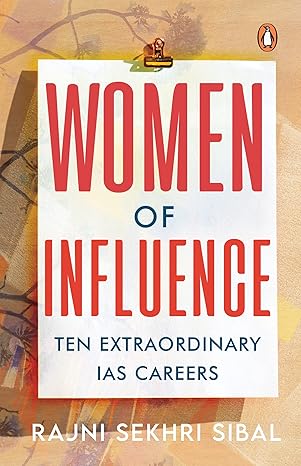
The book starts with,
“When you stand for a cause that’s lofty and true,
stand tall like a tree in the rain,
If the wind is strong and you fall to the ground,
Sprout like an acorn and grow tall again.”
What a wonderful way to describe the exceptional work of the 10 women IAS officers, in
Rajni Sekhri Sibal’s– “Women of influence”.
She is herself an Indian Administrative Service officer. Rajni was the first woman to top the civil services exam in 1986.
The usual approach to bureaucracy is, when in doubt, blame the bureaucrat. If you have any doubts in your mind, watch our news channels, read newspapers and magazines. The truth being, like in all other professions, there are good people and bad. This book successfully throws light on the nicer side of bureaucracy. The challenges bureaucrats face, their difficulties and pressures. The problems, they themselves and their families have to deal with, in their day to day lives. Rajni said, during a book discussion on her book, between the black and the white, it’s very easy to take a call, very easy to decide that the white is right, but it is in areas of grey where you have to use discretion. I guess that discretion defines the temperament of the officer in charge.
This book tells us the stories of 10 women IAS officers, spanning over five decades.
The oldest is set at the Rajasthan border, during the
1965 Indo-Pak war, and the latest is about the UP sand mafia in 2015. Many of us remember the courage with which a young Sub Divisional Magistrate(SDM) Durga Shakti fought against the unlawful mafia. We remember the story because it happened recently and it was all over the news channels. Not many of us have heard about the challenges faced by Otima, a young woman Collector posted in the border area of Bikaner during the Indo-Pak war. While reading her story we don’t forget for a moment that it was the Rajasthan of the 1960’s. Otima’s name, her gender, everything about her, was the talk of the town. She had to prove herself, with her courage and love for the people of her city and her country. Curious rural women, with their face covered in colourful veils, walked for miles to see a woman at the helm of affairs. It is the story of the effort Otima had to put in, just to make them show their faces, so that she could have a reasonable conversation with them. Rural Rajasthan has changed a lot, yet remains the same in many ways. I can say that by my personal experience. I recently visited rural areas of Jaisalmer to cover the elections, most women had their faces covered with veils.
The challenges faced by these 10 women of substance were different, the geographies of the stories are different. The challenges are as varied as, a panchayat election in Punjab during the height of militancy in the 80s, to working in Naxal prone Chanderpur in Maharashtra, to the Perumon tragedy in Kerala.
Rajni mentioned during a book discussion that she hasn’t approached these stories from a gender perspective. A sensitive, passionate about his work male IAS officer, would have acted in the same way. There are some women specific challenges but they are prevalent in all professions. I agree with her, but when I was reading the portion of the book, where during the 1965 Indo-Pak war, Otima sleeps in the bunker with her young daughter in her arms, I am not too sure if it would have made the same kind of impact, if it was the father in the story, instead of a mother.
She has only used the first names of the protagonists and I highly appreciate that. Caste and religion are not important in Rajni’s stories. These are real life incidents not fictionalised stories, written in a simple language which most of us can relate to.
I am eagerly looking forward to part two of “Women of influence”.
As Rajni said, “some stories never get told.” She added, as the author of the book, I do not do not want to put my heroines on a pedestal, it is not my intention to portray that, the protagonists in the book are perfect. We need to know more about many such women of substance.

 Prerna's Photographs