I read The Life of Mahatma Gandhi by Louis Fischer as a teenager. It had more impact on me than all the lectures, plays and songs in my school on Gandhi Jayanti, year after year. It was more impactful than the 1 minute silence that we observed on 30 January every year, to pay respects to the Father of Our Nation. It was more powerful then the chapter from, The Story of My Experiments with Truth, which was a part of our school curriculum. The impact stayed for a few months. I read a couple of more books on Gandhi, they weren’t as interesting, at least to a teenager’s mind. The impact of Gandhi however stayed with me.
I had discussed the book with my Nana and my younger brother. My Nana told me that on 30th January 1948, he was having dinner at a dhaba. That was the fateful day when, Gandhi was assassinated. Must have heard on the radio, I guess. He told me that, every single person eating at that dhaba, stopped eating after hearing the news. They couldn’t eat after that. The impact of the book on me and my brother was that, we decided, we will always tell the truth, whatever the implications. The wow of always telling the truth was strictly followed for a few months. There were a few side effects, but we were proud of ourselves. Both of us still don’t tell a lie until absolutely necessary. I usually follow the no comment way of circumventing the truth. I keep quiet instead of telling a lie, when I don’t have too many choices. In our Sanskrit text book we had read, the maxim, “Satyam bruyat, priyam bruyat, na bruyat satyam apriyam,” which translates to “Speak the truth, the pleasant truth, but not the unpleasant truth”. I guess, it is much better to keep quiet than hurting someone.
For a few years after that, we didn’t talk much about Gandhi. The exceptions being, 2nd October and 30 January. Those were the days when Gandhi was on TV and radio, all day long. We heard Gandhi’s favourite Bhajans and film songs praising Gandhi. My favourite one was, Ishwar Allah tero naam, sabko sanmati de Bhagwan. It still is my favourite. Then came the film, Gandhi by Richard Attenbourough. It took the world by a storm. The movie won eight Academy Awards, including that for best picture, and five Golden Globe Awards, including that for best foreign film. It was also named best film at the BAFTA ceremony and took four additional BAFTA Awards.
After that Gandhi wasn’t forgotten, but not remembered unless and until somewhere a controversy erupted, or someone made a comment on Gandhi that hurt. For example an elderly person, not a Gandhi fan, once told me that he was watching a film in a theatre in Delhi, suddenly the screening of the film had stopped, as the news of the assassination of Gandhi had spread. He held a grudge against Gandhi for that, till he died a couple of decades ago.
On 30th September, I attended an illustrated talk organised by the Sarvodaya International Trust– Delhi Chapter, on the occasion of Gandhi Jayanti. Pramod Kapoor ji, the author of the the book, Gandhi, an illustrated biography spoke about the short film, ‘on the the making of Gandhi’. It was screened before the conversation started. The conversation was moderated by inimitable Prof Pushpesh Pant and chaired by the internationally renowned psychologist, psychoanalyst and sociologist, Dr Ashis Nandy.
There was nothing new in the film, I had seen and read all that was shown in the short film, yet it made me emotional. It touched my heart. While talking about the differences between Gandhi and his Hira Lal, Professor Pushpesh Pant in his usual humourous way remarked, what is unusual about a son not getting along well with his father. This happens in every family.
I had read somewhere, Rajmohan Gandhi, the grandson of Gandhi had said- “The story of Gandhi is not only the story of India and partition: it is also the story of a father with high expectations and four sons who found it hard to measure up.”
Hari Lal lived in the shadow of his father all his life and rebelled against him. He converted to Islam and changed his name to Abdullah. One of the reasons why he was upset with his father was, when there was an opportunity to send one of his sons to England on a scholarship, Gandhi suggested the names of two other boys. He believed that they were more deserving. Or Gandhi didn’t want people to accuse him of nepotism.
“You want to make saints out of my boys before they are men,” complained his wife but, for Gandhi, his family was expected to be a symbol of India of his dreams.
The film, “Gandhi, My Father,” was based on the relations of Gandhi and his son Hari Lal. A reviewer had posted, it is the extraordinary story of the son and the man “the greatest father you can have but the one father I wish I did not have”.
The conflict between the father of the nation, and the father of his children would have been so difficult to handle. For Ba it would have been even more difficult. It is evident from the excerpts of this emotional letter written by her to Hari Lal on 27th September, 1936.
“Every morning, I rise with a shudder to think what fresh news of disgrace the newspapers will bring. I sometimes wonder where you are, where you sleep and what you eat. Perhaps, you take forbidden food. That and other similar thoughts give me sleepless nights. I often feel like meeting you. But I do not know where to find you.”
Gandhi believed that for the larger good of the society, each individual needs to make sacrifices. Rajmohan Gandhi wrote, “The hallmark of a leader is that, they expand the notion of a family to include the entire nation, and so do not do anything special for their children.”
Not easy to make personal sacrifices for the nation, even more difficult to expect your family to make sacrifices. It is possible however, to follow the Gandhian principle of love and non-violence. All the hatred and violence that is happening around the world is scary.
Albert Einstein said about Gandhi- “Generations to come will scarce believe that such a one as this ever in flesh and blood walked upon this earth.” It may sound impossible, but the world needs a Gandhi in every city of the world to fight the bloodshed and hatred that we see everywhere in the world.
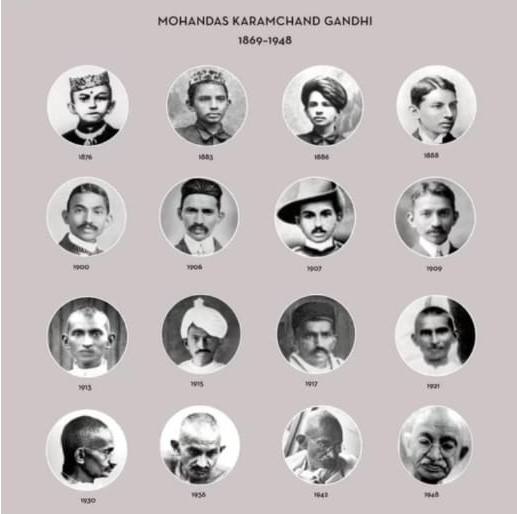
The featured picture used in this post is from the Mr Pramod Kumar’s amazing pictorial biography of Mahatma Gandhi – Gandhi, An Illustrated Biography this book is a treasure chest of photographs for Gandhi fans.


 Prerna's Photographs