People of my generation would sing a hindi song when they were bored in their history class, “Sikander ne Porus se ki thi ladai, jo kee thee ladai to main kya karoon(So what if Alexander fought with Porus, how is that my business)”.
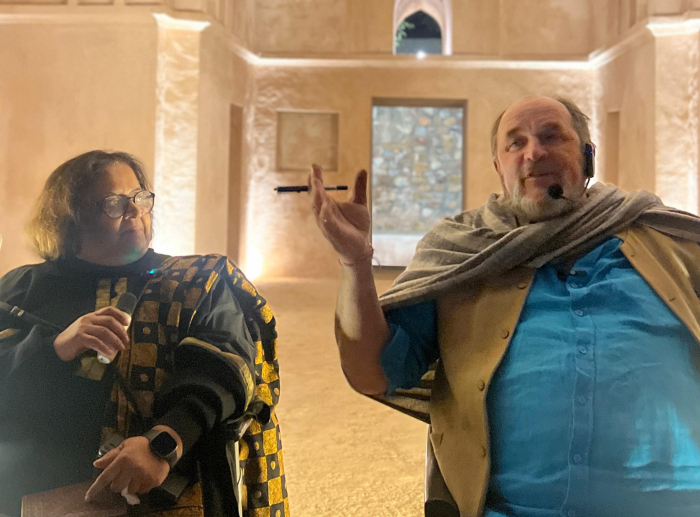
William Dalrymple has a solution for this boredom. He makes history interesting by not just telling about it, but also adding Geography, Architecture, Science, and Maths, to spice it up. His latest book, The Golden Road, is a tale of tales—a very interesting literary history. It is a tale of some beautifully interwoven, well-researched stories about ancient India between approximately 250BC and AD1200. The era in which, in his words, India “transformed the world.” Indian tales such as The Ramayana captured the imaginations of virtually every civilisation in the Old World. He uses the term Indosphere in the book. During my recent conversation with him, I asked him about the term. He said, that by Indosphere, he means the cultural identity of India, not the political identity.

The Golden Road, is a well-researched book. William Dalrymple travelled to places as far as Ankorvat and Afghanistan for the research. The book contains some amazing photographs, most of which were clicked by Dalrymple. The book has been well received, and the photographs deserve a special mention.

There are two distinct stories in the book. The first story is, the trading relationship with Rome, which is why the book is named ‘The Golden Road’.
Gold is also a metaphor, symbolising the preciousness of knowledge, which is the second story. The diffusion of Indian philosophical knowledge and religious ideas to China and Southeast Asia and mathematics to the Middle East.
History can be manipulated by propaganda. The propaganda about “the Silk Road being a major trade route in the old world,” is evidence of that.
A quote from, ‘The Golden Road’ – “Goods from China largely reached Rome merely as an exotic supplement to its thriving commerce with India … Silk was never the main commodity imported to the West from the East … the Silk Route barely existed in antiquity.”
Revisiting History at regular intervals is needed, as proved by the new historical evidence that has come to light recently. Muzuris Papyrus, was discovered as late as 1985. It is a loan agreement signed between a merchant and a financier from Alexandria, Egypt, for an expedition to Muziris, Kerala. It is perhaps the only ‘primary document’ which records Kerala’s maritime, and cultural interfaces in the second century AD. An idol of Budha which was excavated in Bernike even more recently has brought so many new facts to light. Dalrymple has written about it in detail, in his book.
My favourite story in the book starts with Aryabhatta in Patna and Brahmdatta in Mount Abu, leading to the greatest genius of all time, Leonardo Da Vinci.
Another favourite story of mine from the book is the story of Wu Zetian, the only female Empress of China. It is a classic example of misusing religion for political gains. Xuanzang, who had come to visit Nalanda University and stayed in India for 17 years, had a small role in it. He also helped a great deal in understanding the Buddhist world in India, during that time.
There are some very fascinating anecdotes in the book. At a time when the yearly wage of a Roman soldier was about 900 sesterces, Roman Emperor Caligula’s consort Lollia Paulina wore forty million sesterces’ worth of Indian emeralds and pearls, not just that she carried around the receipts with her to prove their worth. Pliny the Elder, the Roman author called India “the sink of the world’s most precious metals”.

The Geography of India played a major role in the trade between India and Europe. Understanding the direction and timing of the monsoon winds created the Golden Road connecting Rome and India.
I hope there is a sequel to “The Golden Road”. After digging a few inches deep, in ‘The Golden Road part 2’, William Dalrymple might discover that like chess and the modern accounting system, the game of cricket was invented by India.
The pictures in this post have been taken from the Amazon website, and the text is by Prerna Jain


 Prerna's Photographs