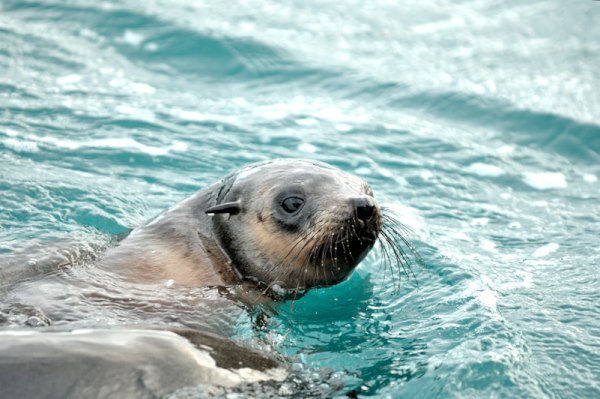
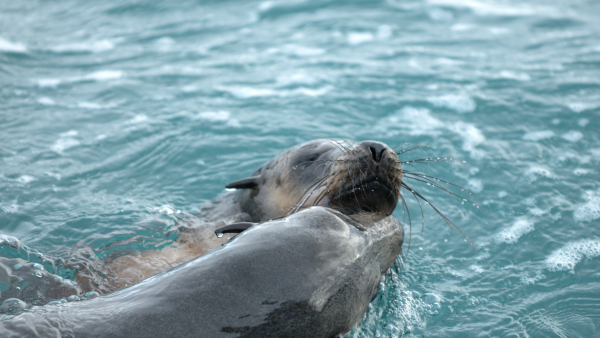
It was an unforgettable sight. There was excitement all over as our boat drifted close to a seal colony. We were at Seal Rocks, the far south-western tip of Phillip Island, in Victoria, Australia. There were thousands of fur seals. We were close enough to see their large eyes, pointed face, whiskers and sharp teeth. They were everywhere, flopping in the cool water, basking in the sun on the rocks. It was freezing cold and windy, and it was difficult to hold the Camera. Some seals approached our boat for a closer look at us, and I was able to take a few good clicks of these playful creatures in their natural environment.

Australian Fur Seals are semi-aquatic mammals; they feed in water and breed on land. They are carnivores that primarily feed on fish. Australian Fur Seals are agile swimmers and can dive as deep as 200 m to catch fish and squids. They don’t need to eat every day because they have a layer of blubber that stores fat, allowing them to survive for long periods without food.
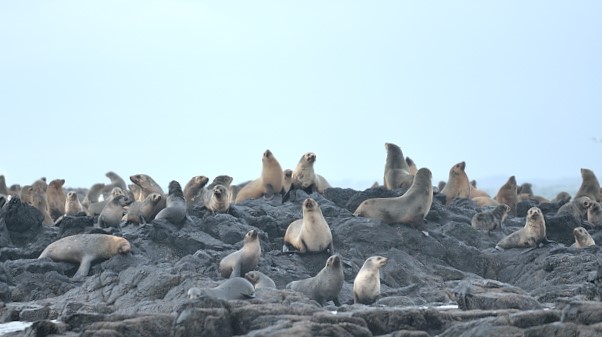
Australian Fur Seals move around comfortably on land, even over rocky terrains. They can use all four limbs to move across land and can raise their body onto their front flippers to propel themselves forward. Their movement on land is called galumphing. They move by flopping along on their bellies. The process of coming ashore is called ‘hauling out’.
The Australian Fur Seals are sexually dimorphic. Males are larger than the females, and mature ones carry a dark mane of hair. Male seals are known as bulls, females are known as cows.
They prefer rocky islands for breeding. Fur seals come ashore to form breeding colonies. The adult males come ashore first and establish their territories. Females assemble in these areas and are defended by the resident male. Most of the gestation period is spent at sea. They come ashore just before the birth of the pup, mostly one or sometimes two.
A fertilised egg remains dormant for some time before implanting and resuming development. It is called delayed implantation. This is to ensure the birth of the pups in the summer, when the weather is warm and there is an abundance of food available. The survival chances are maximised due to this.

Fur seals have external ears, unlike other seals.
Like many aquatic animals, Fur Seals face numerous dangers. They can be eaten by several predators, including some species of sharks. Hunted for their meat, fur, and blubber, they were nearly wiped out by sealers in the 19th century. Fishing also poses risks to seals. Seals can get entangled in discarded fishing gear.
The area around Seal Rocks is now a protected wildlife reserve, and the seal population is increasing. It is one of the largest colonies of Fur Seals (Arctocephalus pusillus doriferus) in Australia. Seal Rocks has more than 25,000 fur seals.
Photos and text by Prerna Jain.

 Prerna's Photographs