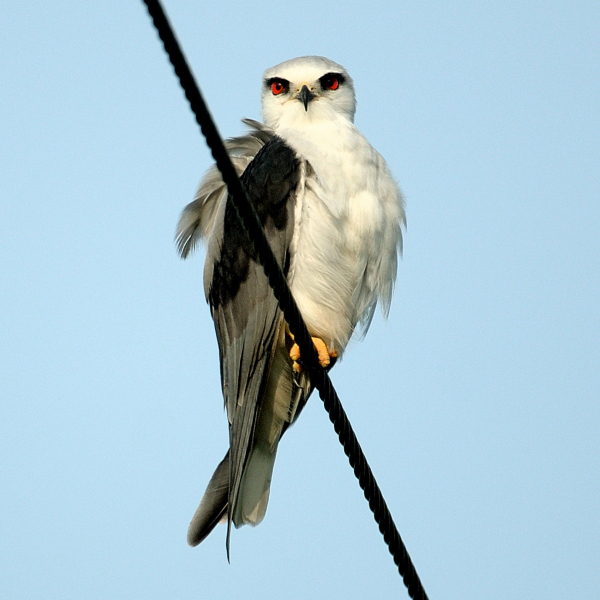
Kites are birds of prey known for their distinctive flight. They hover into the wind and soar into the sky for long periods. They are mentioned in the Bible, known for their keen eyesight and swift flight. Kites are classified among the unclean birds in the Mosaic Law and are prohibited from consumption. In Rudyard Kipling’s “The Jungle Book,” Cheel (Kite) is portrayed as a keen observer, soaring in the sky to keep a watch over the jungle.
There are many types of kites found in India. Among them, I consider the Black-shouldered or the Black-winged kite to be the good-looking one. It is a medium-sized kite with a perfect blend of black, white, and grey feathers. These kites are called the Black-shouldered kites because of the blackish shoulder patches on their wings. They have a white underbelly and deep, blood-red piercing eyes, which cannot be missed even from a distance. The eyes are highlighted by dark eyebrows and eye patches. The nostrils, legs and feet are yellow. Female Black-winged Kites are larger than males. The colour of the eyes darkens with age, from yellowish in juveniles to orange in subadults, which changes to deep red in mature adults.
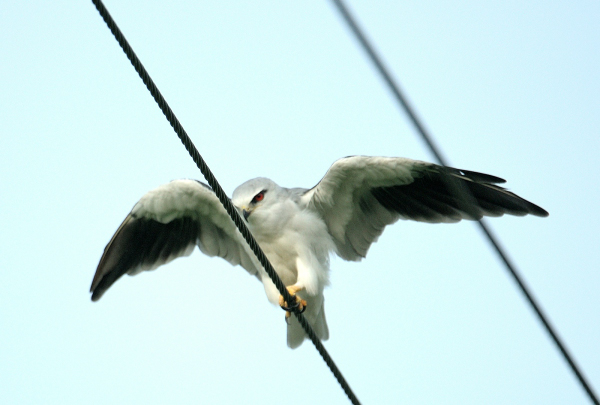
The black-shouldered kite, perched on an electric wire, adjusted its wings and tail to balance itself.

The Black-winged Kite prefers to inhabit open areas such as grasslands, agricultural areas, dry shrub thickets, clearings within forests, marshes, and pastures. You might find it hovering low over open fields, before dawn and during the twilight hours.
It is an expert rodent hunter. Sitting on a perch waiting for unsuspecting prey, it scoops its prey from the ground. Other than rodents, it eats reptiles, insects, bats, larks, doves and other birds. Another hunting technique of theirs has given them the name kite. They hover over the prey, like a paper kite at the end of its string, and then dive swiftly to capture it. This hunting move is called “kiting,” hence the name kite.
Photos and text by Prerna Jain.

 Prerna's Photographs