
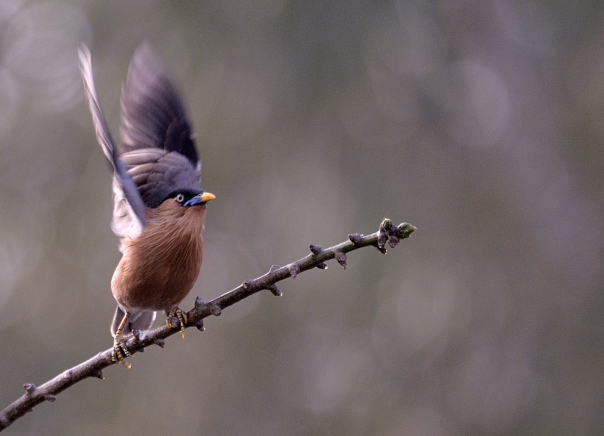
The Brahminy Starling is one of the most elegant and striking birds found across the Indian subcontinent. Its dark, wispy crest resembles the traditional shaved head with a single tuft of hair, or shikha, once commonly worn by Brahmin priests. This distinctive appearance is what gave the bird its name.
Its scientific name, Sturnia pagodarum, has an equally fascinating origin. The bird was often seen roosting and nesting in the crevices and niches of ancient pagodas and temples, inspiring early naturalists to associate it with these historic structures.
The Brahminy Starling is beautifully coloured, with soft grey plumage on the upper body and a warm reddish-fawn shade below. Its yellow bill, with a bluish base, stands out against the pale eyes and the striking blue skin around them. Adding to its charm is the glossy black crown, long crest, black wing quills, and a brown tail tipped with white.
Like most starlings, the Brahminy Starling is omnivorous. It feeds on fruits, nectar, and insects, foraging both on the ground and among tree branches. Beyond its beauty, the bird is also known for its intelligent nesting habits. It is believed to line its nest with leaves from medicinal trees such as Neem, possibly to keep parasites away. The Brahminy Starling is one of the most fascinating birds to watch in the wild.

Brahminy Starlings are grey coloured on top and reddish fawn below.

Their bill is yellow with a bluish base, the iris is pale, and there is a bluish patch of skin around the eye.

Like most starlings, this species is omnivorous. You can see them feeding on fruits and nectar, as well as on insects on the ground or in the trees.
Text and photos by Prerna Jain.
