
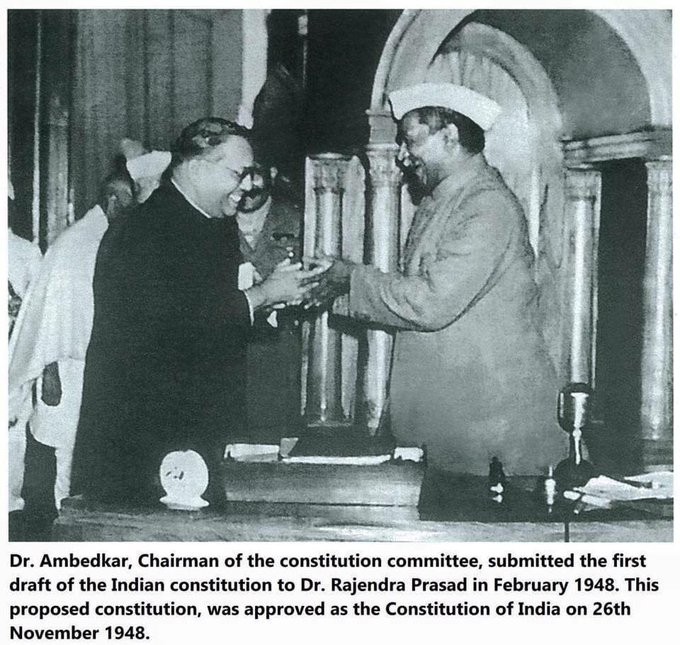
Dr Babasaheb Bhimrao Ambedkar lost more elections than he won, yet his relevance in contemporary India is unmistakable. Political parties across the spectrum seek to claim his legacy, a testament to his enduring influence. His statues depicting him holding a copy of the Constitution in one hand, the other outstretched with a pointing finger, stand across the country as reminders of his vision and authority.
Ambedkar, one of modern India’s foremost economic thinkers, the principal architect of the Constitution, and the nation’s first Law Minister, occupies a place in history alongside figures like Gandhi and Nehru. Yet, his contribution is not merely institutional; it is deeply moral and transformative.
In his address to the Constituent Assembly during the adoption of the Constitution, he observed:
“I have completed my work; I wish there should be a sunrise even tomorrow. The new Bharat has got political freedom, but it is yet to raise the sun of social and economic liberty.”
That Constitution, drafted by an Assembly largely composed of orthodox upper-caste members, under the leadership of a Dalit chairman of the Drafting Committee, remains one of India’s most enduring achievements. Despite being a sharp critic of the Congress party on several issues, Ambedkar worked closely with its leaders in shaping the Constitution and later joined Jawaharlal Nehru’s cabinet as independent India’s first Law Minister. His commitment to the nation rose above political differences.
Ambedkar also issued a profound warning:
“On the 26th January 1950, we are going to enter into a life of contradictions. In politics, we will have equality, and in social and economic life, we will have inequality.”
He strongly advocated for individual liberties to be enshrined as fundamental rights, yet he remained realistic about their limits. As he cautioned:
“The prevalent view is that once rights are enacted in law, they are safeguarded. This is an unwarranted assumption. Rights are protected not by law but by the social and moral conscience of society.”
Born in 1891 into a so-called “untouchable” Mahar family, Ambedkar’s early life was marked by humiliation and exclusion. Denied the dignity afforded to other children, he was made to sit on a gunny sack in school and punished for acts as basic as drinking water from a common source. Such experiences might have crushed many, but not him.
Ambedkar rose above these injustices through sheer determination and intellect. He earned scholarships to study abroad and went on to become one of the most highly educated Indians of his time, with degrees from the University of Bombay, Columbia University, and the London School of Economics, where he completed a doctorate in economics. More importantly, he instilled among Dalits a sense of dignity, collective pride, and self-respect.
He consistently emphasised education as the primary instrument of liberation. His powerful call still resonates:
“Educate, agitate, and organise; have faith in yourself. With justice on our side, I do not see how we can lose our battle… Ours is a battle not for wealth or power, but for freedom, for the reclamation of human personality.”
Today, as political parties compete to appropriate his legacy, one cannot help but wonder how Ambedkar himself would respond. It is unlikely that he would find much comfort in symbolic reverence without a corresponding commitment to his ideals.


Photos downloaded from the internet.
