
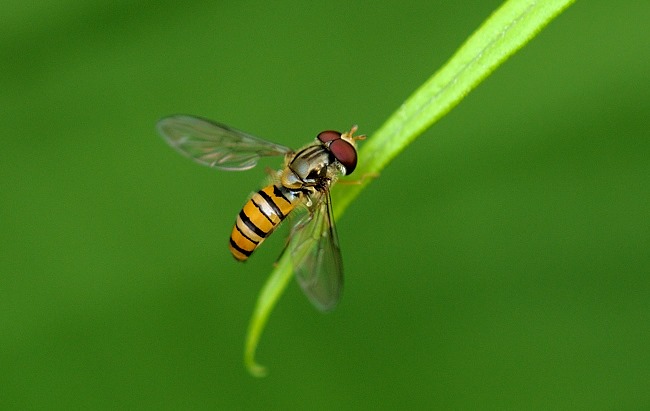
Butterflies seem to have a PR team, and bees, too, have a fan club. Hoverflies, meanwhile, are out there working incessantly for the ecosystem with almost no recognition whatsoever.
Adult hoverflies help with pollination, while their larvae are “aphidophagous”; they eat aphids. One hoverfly larva can consume hundreds of aphids in its lifetime. Hoverflies can hover in mid-air like miniature helicopters, zip forwards, backwards, sideways, up, or down. Female hoverflies use these skills to lay eggs directly on pest insects. Once the eggs hatch, the larvae begin their first meal from within, leaving behind only an empty shell.
India is home to more than 350 species of hoverflies (family Syrphidae), yet most of us walk past them thinking, “Oh no, a bee!” With their yellow-and-black stripes, hoverflies mimic bees and wasps despite having absolutely no equipment to sting anyone.
Their whole vibe reminds me of an old Khadi Boli Hindi two-liner:
“Hum tunak munak, tum ode bade,
Hum karein thay khiladi, tum ro padey.”
Roughly translated: “We’re tiny little things, you’re so big, all we wanted to do was to play, and you started crying.” Which is exactly what hoverflies would say if humans stopped flapping their arms every time one came near.
Hoverflies are flies because they have only one pair of wings. Mosquitoes and houseflies are their distant relatives, though hoverflies are the glamorous cousins. They are colourful, useful, harmless, and stylish. They still end up as snacks for birds, reptiles, and small mammals. No matter how good-looking you are, somebody higher up the food chain still sees you as protein.


Text and photos by Prerna Jain.
