
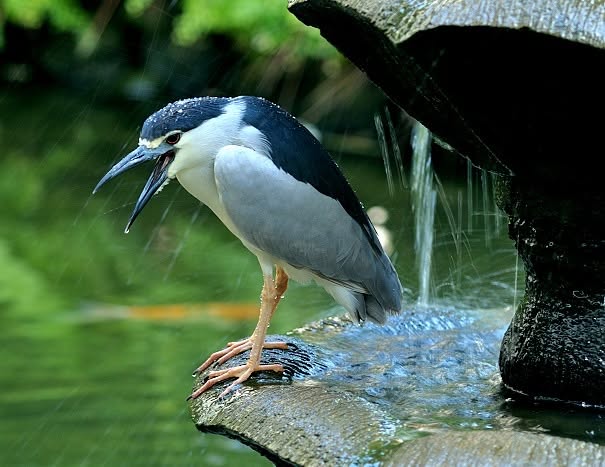
Over the years, I have clicked lots of pictures of the Black-crowned Night Herons in various parts of the world. It is one of the most widely distributed herons. I recently came across an innocent yet delightfully mischievous Vietnamese nursery rhyme featuring the Black-crowned Night Heron (Nycticorax nycticorax). In Vietnamese, the bird is called Vạc, an onomatopoeic name that echoes its characteristic call.
The Vạc occupies a special place in Vietnamese culture and folklore, particularly in traditional children’s songs. One of the most beloved nursery rhymes, “Cái cò cái vạc cái nông,” tells a humorous story involving a farmer and a group of birds, including a stork and a night heron. Accused of trampling his rice field, the heron responds with smart confidence.
“Sao mày dẫm lúa nhà ông hỡi cò?”
“Không không tôi đứng trên bờ,
Mẹ con nhà nó đỗ ngơ cho tôi.
Chẳng tin thì ông đi đôi,
Mẹ con nhà nó còn ngồi đây kia.”
(“Oh, heron, why are you trampling on my rice?”
“No, no, I was just standing on the riverbank.
That mother and child(Storks) over there falsely blamed me.
If you don’t believe me, go and see for yourself,
They’re still sitting right there.”)
The excuse is both clever and amusing. The heron doesn’t even bother denying that it was present at the scene.
The Black-crowned Night Heron has a short black bill, short legs, and scarlet-red eyes. Its scientific name, Nycticorax, comes from Greek and means “night raven.” The name refers to its croaking, raven-like wock-wock call, which often echoes through wetlands after sunset. It is their announcement of dusk.
The Black-crowned Night Heron is nocturnal and is most active at dusk and at night, spending daylight hours resting quietly in trees or dense vegetation. It can be found around wetland habitats, lakes, ponds, rivers, marshes, and mangroves.
Male and female Black-crowned Night Herons look very similar, and it is difficult to distinguish between them. During the breeding season, both sexes develop long white plumes that sprout from the back of the head, and their normally yellow-green legs turn shades of pink.
This species has developed some fascinating hunting techniques. One of the most interesting ones is known as bill vibrating, performed during the low-light hours of dawn or dusk. The bird rapidly opens and closes its bill underwater, creating tiny ripples and vibrations. Curious fish and other aquatic creatures, curious about the disturbance, discover that they have been trapped.

Black Crowned Night Heron In Bharatpur


Photos and text by Prerna Jain.
