
The idea of boundaries in relationships feels surprisingly new to my generation. Until a few years ago, nobody seemed to talk much about them. Then came therapists, self-help books, podcasts, YouTube gurus and wellness workshops, all patiently explaining that there is nothing wrong with saying no. Some of us learned the lesson the hard way, after exhausting ourselves trying to please everyone else.
We could have learned it much earlier from Euphorbia milii. Better known as the Crown of Thorns, this remarkable succulent has understood boundaries for millions of years.
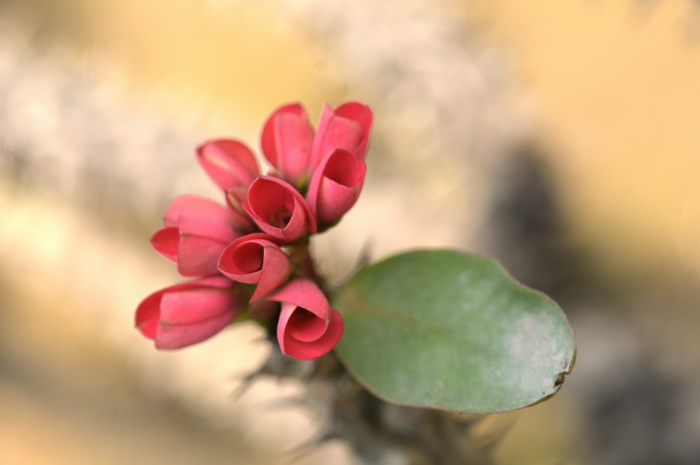
Its stems are armed with sharp thorns to discourage hungry animals, curious children and overenthusiastic gardeners. In the middle of this formidable armour appear clusters of cheerful red, pink or yellow blooms, as though the plant suddenly remembered that duniyadari bhi koi cheez hoti hai(one cannot ignore the realities of the world). Looking attractive is part of its job description. Except that those bright “flowers” are not flowers at all. They are colourful bracts, modified leaves, putting on a spectacular performance. The real flowers are tiny, almost invisible nectar-bearing structures tucked discreetly in the centre.
The Crown of Thorns is wonderfully clear about its terms and conditions. The plant never sends mixed signals. Touch it carelessly, and the thorns will introduce themselves. Prune it, and a sticky white latex sap appears immediately. The sap can irritate the skin and eyes, so experienced gardeners handle it with respect. It doesn’t appreciate overindulgence. Water it too frequently, and it sulks. Neglect it a little, and it thrives. Its philosophy seems to be jiyo aur jeene do, live and let live.
The more I watch it, the more it resembles an emotionally healthy human being.
“Please admire me, photograph me, tell everyone how beautiful I am, but my personal space is not a public park.”
Imagine if people came with such honest warning labels. We could avoid awkward conversations and passive-aggressive hints. A careful look, a respectful distance, I appreciate you. I also respect your space.
Native to Madagascar, Euphorbia milii grew up where drought is a way of life. It stores water in its thick succulent stems and survives intense heat with composure, accepting high temperatures much the way Delhi commuters accept traffic jams. Its common name, Crown of Thorns, comes from a Christian tradition that associates the plant with the crown placed upon Jesus Christ before the Crucifixion. Whether the historical connection is botanically or historically accurate remains uncertain, but the symbolism has endured for centuries. The combination of fierce thorns and delicate blooms has made the plant a lasting emblem of suffering, resilience and hope.
As they say in Urdu, Gulon se ḳhaar behtar hain jo daman tham lete hain.
(Better than flowers are the thorns that catch hold of your robe).
Thorns may be uncomfortable, but they prevent thoughtless closeness. Sometimes the things that protect us deserve more gratitude than the things that merely delight us.
Nature invented thorns millions of years before humans invented phrases like “Respect my boundaries”.


Text and photos by Prerna Jain.


