
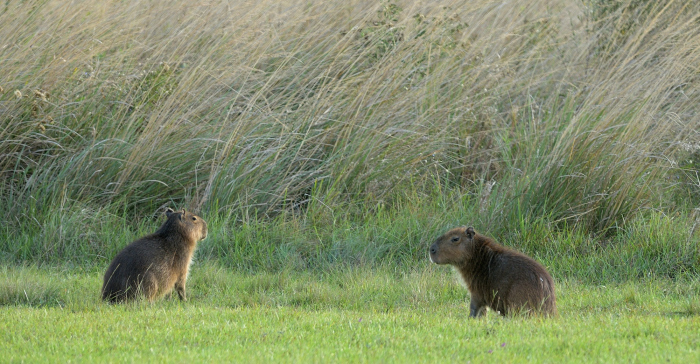
We are living in an age when history is rewritten one name at a time. Cities, roads, railway stations, and even historical figures acquire new identities with remarkable regularity. While reading about the capybara, I realised that names have always been surprisingly flexible. For centuries, a rodent became a fish simply because it suited human convenience.
Shakespeare famously wrote, “What’s in a name? That which we call a rose by any other name would smell as sweet.” The capybara, however, might have replied, “Perhaps, but if you call me a fish, I may end up on a Friday dinner plate.”
Capybaras are semi-aquatic mammals, spending part of their lives on land and part in water. Ironically, the very adaptation that helps them escape natural predators once made them more vulnerable to humans.
During the Middle Ages, Catholics were forbidden from eating meat during Lent. Following the European colonisation of South America between the sixteenth and eighteenth centuries, missionaries in Venezuela sought guidance from the Vatican on whether this unfamiliar animal could be eaten during the fasting season. Since capybaras had webbed feet, spent much of their lives in water, and were even said to taste rather like fish, they seemed to fit the bill. The Church agreed.
With one pastoral decision, the world’s largest rodent acquired a new identity. The capybara was, for culinary purposes, declared a fish and promptly found its way onto Lenten dinner tables. Apparently, spend enough time in water and someone, somewhere, will eventually decide you belong on the menu.
I first encountered this remarkable creature in a zoo. It looked like a guinea pig that had spent years lifting weights. Fascinated, I promised myself I would one day see capybaras where they truly belonged, not behind concrete barriers, but in the wild.
That opportunity came in Argentina’s Ibera Wetlands. I watched capybaras grazing peacefully, basking in the sun, and slipping effortlessly into the water at the slightest disturbance. They moved with the quiet confidence of animals that know they are too large to be bullied and too relaxed to be bothered.
Capybaras inhabit rainforests, grasslands, marshes, and wetlands across much of South America, but they are almost never found far from water. Rivers, ponds, and swamps are not merely habitats; they are their refuge. At the first sign of danger, they dive beneath the surface with surprising speed.
Everything about their anatomy reflects this amphibious lifestyle. Their webbed feet make them excellent swimmers, while their eyes, ears, and nostrils sit high on their heads, allowing them to remain almost completely submerged while keeping watch. They can stay underwater for around five minutes and have even been observed sleeping in water with only their noses exposed to breathe. Their coarse reddish-brown fur dries quickly once they emerge, a useful adaptation, because nobody enjoys spending the day looking like a soggy doormat.
Hydrochoerus hydrochaeris, the larger of the two capybara species, grows up to 1.3 metres in length and can weigh nearly 80 kilograms. Like all rodents, their incisors grow continuously, so they spend much of their day grazing to keep them worn down. They feed primarily on grasses and aquatic plants, in effect, oversized lawnmowers with Olympic-level swimming skills.
Their digestive system is equally ingenious. Like cattle, capybaras rechew partially digested food to extract more nutrients. They also practice coprophagy, consuming their own faeces immediately after excretion. This behaviour enables them to digest tough plant fibres efficiently and replenish beneficial gut bacteria. Nature, it seems, has little concern for our notions of etiquette.
Capybaras are highly social animals. They live in herds, sometimes numbering more than twenty individuals, and communicate through an astonishing repertoire of purrs, whistles, barks, squeals, grunts, cackles, and teeth chattering. Each call has a purpose, whether locating companions or warning of danger. When threatened, the entire group erupts into alarm barks, a remarkably organised panic. Scent plays an equally important role in their society. They mark vegetation to establish territories, signal reproductive readiness, and reinforce social hierarchies. Even courtship has its own aquatic rulebook, as mating takes place exclusively in water. Females, slightly larger than males, usually produce one litter of three to eight pups each year. Apparently, even romance requires a swimming pool.
Perhaps the most endearing aspect of capybara society is their communal approach to childcare. Nursing females readily feed not only their own offspring but also those of other mothers, a behaviour known as allonursing. It greatly improves the survival of the young and makes the capybara one of nature’s finest examples of cooperative parenting. It is the closest thing the animal kingdom has to a neighbourhood crèche.
The English word capybara comes from the Guaraní Kapiÿva, meaning “lord of the grass.” Its scientific name, Hydrochoerus hydrochaeris, translates rather less majestically as “water hog.”
Whenever I think of capybaras, an old Hindi proverb comes to mind, “Bakre ki maa kab tak khair manayegi?”, How long can the goat’s mother pray for its safety? Fate, after all, has an odd sense of humour. The capybara did nothing more than evolve to live comfortably in water. Humans took one look, changed its name, and changed its destiny. In the end, it wasn’t biology that mattered. It was the label.


Photos and text by Prerna Jain.
