
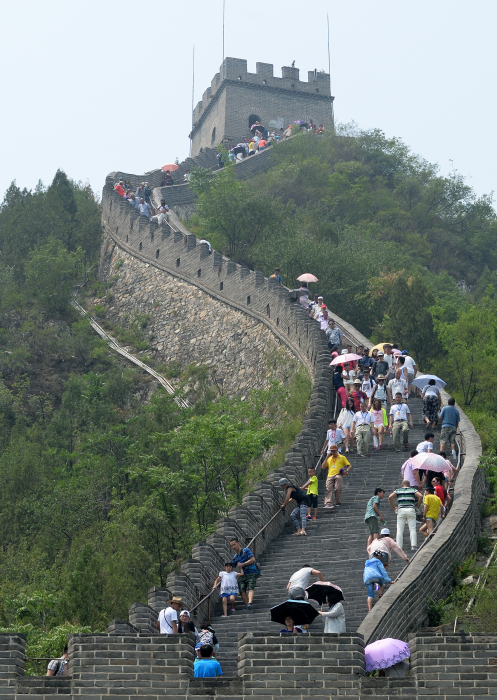

The Great Wall of China is a journey through history. Stretching across mountains and valleys, climbing steep slopes, it disappears into the distance. Built and rebuilt over centuries, it was meant to protect China from invasions. It stretches for thousands of kilometres across China, winding over mountains, through valleys and across some very difficult terrain. From a distance, it appears almost poetic, a stone dragon sleeping across the hills. Standing there and looking at the endless wall winding through the mountains is humbling. It is ancient, historic and an extraordinary feat of engineering. Millions of people, countless years and an enormous amount of human effort went into creating it.
Walking on the wall, however, is both breathtaking and exhausting. The views are spectacular, but after a few steps, you miss a lift. These are not the polite little steps we are accustomed to in modern buildings, where every step is roughly the same height, and somebody has thoughtfully installed a railing.
Some steps are high. Some are low. You climb one flight thinking, The top is just there.
Your brain says, “Beautiful!”
Your legs say, “Absolutely not.”
Despite the exhaustion, there is something magical about the Great Wall. The wall rises and falls with the mountains, disappears around bends and suddenly reappears on a distant ridge. Monuments survive not merely because they are made of stone, but because they carry the imagination, labour and stubbornness of generations. The Great Wall reminds us what human beings can accomplish when they are determined.
By the time I came down, my legs had stopped belonging to me.
But I had walked on the Great Wall of China.


Photos and text by Prerna Jain.


