
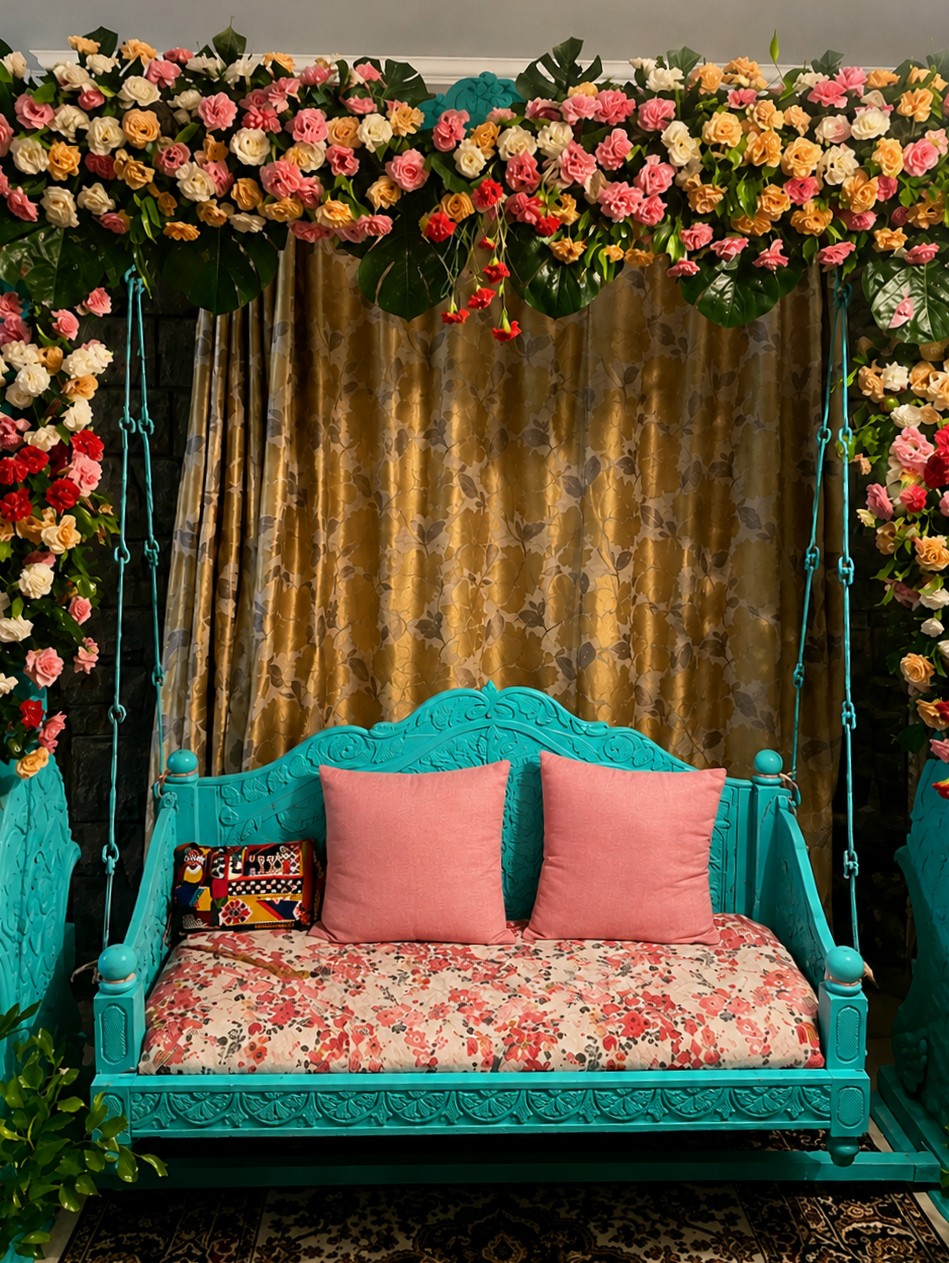

There are festivals that celebrate Gods. Festivals that celebrate harvests. Festivals that celebrate victory. And then there is our version of Teej, our wonderfully extravagant celebration of bangles, mehendi, swings, monsoon clouds, songs, dressing up and gossip. A festival that arrives with the rain, when the earth smells divine, and the trees look as if they have finally had a bath.
For centuries, women have been given endless opportunities to prove their devotion. Fast for him. Pray for them. Take care of everyone. Remember everyone’s birthdays. Know where the spare keys are. Make sure nobody leaves the house hungry. Remember who takes sugar in their tea and who has a gluten intolerance. Keep the family calendar in your head. Do all this without complaining.
Women have been celebrated for their ability to care, adjust, compromise and sacrifice. The ability to have a good time has received very little attention. Which is why I like our version of Teej. For once, a woman is not required to be anybody’s anything. Not somebody’s wife. Not somebody’s mother. Not somebody’s daughter-in-law. Not the family event manager. Not the keeper of everyone’s medical reports. Not the person who knows where the extra bedsheets are. Just a woman.
She could be a young woman trying to build a career. A mother who has not had ten uninterrupted minutes to herself in decades. A grandmother whose stories nobody has had the patience to hear lately. A single woman happily living on her own terms. A widow rebuilding her life. A woman who has never married. A woman who married and wishes she hadn’t. A woman who didn’t marry and is tired of explaining why. A woman who fell in love. A woman who fell out of love. A woman who started again. Or a woman who has absolutely no idea what she wants yet. They all qualify. There is no application form. No eligibility criteria. No committee deciding whether she is enjoying herself correctly. If she wants to celebrate, wonderful. If she doesn’t, that’s wonderful too.
The swing is a perfect symbol of Teej. A woman sits down, pushes herself forward and suddenly she is in the air. Her dupatta flies. Her bangles make music. She laughs. For a few glorious seconds, nobody is asking her to do anything. No one needs her to remember something, organise something, cook something, fix something or find something that has been lying in the house for three years and which everybody suddenly needs urgently. There is just air, movement and joy. The swing goes forward and backwards, forward and backwards, and somehow that feels like an excellent metaphor for women’s lives. So much of life is negotiation between moving forward and being pulled back. But for a few seconds, there is only forward. She is not escaping her life. She is simply enjoying it. And perhaps that is the point of a festival. Festivals are supposed to bring joy. They should not become another performance review for women. If she wants to wear a silk sari and spend three hours having elaborate mehendi applied to her hands, let her. If she wants to wear jeans, order something delicious and watch television all afternoon, that counts too. If she wants to swing from a tree, let her swing. If she would rather sit under the tree and watch everyone else swing, equally valid. There should be no cultural police stationed nearby.
The songs of Teej are perhaps even more interesting. Women’s folk songs have traditionally been full of longing, teasing, complaint, desire, homesickness and humour. They gave women a way to say what polite society expected them to swallow. The husband is annoying. The in-laws are impossible. I miss my mother. I want to go home. I have had enough. And yes, I would like some jewellery too. It was, in its own way, a remarkably efficient communication system. Why waste an evening explaining your emotional condition when you could put it into a song and have the entire neighbourhood sing along?
Let the bangles jingle. Let the mehendi darken. Let the swings go higher. Let the women laugh loudly enough to be heard in the next lane. Let them gossip. Let them eat. Let them dress up for no reason. Let them take photographs. Let them meet their friends. Let them talk about things other than husbands, children, schools, grocery lists and family obligations. Let them dream. Let them change their minds. Let them say no. Let them say yes. Let them do absolutely nothing.
For once, let nobody ask them why. Just for a day, women can be ordinary human beings. Human beings who laugh too loudly, eat too much, change their minds, complain about their husbands, ignore their phones, wear something they love, meet their friends, tell stories, take terrible photographs and yet be happy. Happy without a reason.
Happy Teej.


Text and pictures by Prerna Jain.
