

The 80s are back, at least on social media. With AI, people are turning their photographs into 1980s portraits: big hair, dramatic shoulders, oversized sunglasses and bright clothes. People are having fun going back to a decade they may never actually have lived in. I don’t need AI to take me to the 80s. I was there. And when I think of that decade, I remember the world coming to India.
In 1982, Delhi hosted the Asian Games. New stadiums, improved roads, decorations, unfamiliar flags and athletes from across Asia suddenly became part of our everyday surroundings. The Games’ logo was inspired by the Misra Yantra, one of the four astronomical instruments at Delhi’s Jantar Mantar, while the mascot, Appu, a young elephant, quickly became a familiar face. The Games changed television forever. Doordarshan began colour broadcasts, and the world appeared in colour in our living rooms. President Zail Singh opened the Games, Geeta Zutshi led the athletes’ oath, and the opening ceremony at Jawaharlal Nehru Stadium drew a crowd of about 75,000. Doordarshan was still the centre of our television universe. When the Asian Games came on, we watched. No smartphones distracted us, no social media feeds competed for attention, and no instant videos waited to be watched. The whole family sat in front of the television. I remember watching the swimming events with my grandmother. She was quite shocked by what she saw, not the competition, but the clothes the women swimmers were wearing. For her, the swimming costume seemed almost as extraordinary as the international sporting event itself. The Asian Games brought a world we had mostly read about into our homes and neighbourhoods. We watched it together, with a sense of wonder that is perhaps harder to imagine today.
Then came 1983, when Delhi hosted the seventh Non-Aligned Movement Summit. Leaders from across Asia, Africa and Latin America arrived in the capital, and suddenly people we knew from newspapers and television were no longer distant names. They were here, in our city. Delhi was cleaned, decorated and polished for its international guests. The city has always had this talent: give it an important visitor, and it can produce flowers, fresh paint and good behaviour almost overnight. But no one tried to mask its less pleasant sights completely. The dust, busy roads and everyday chaos were still there. At the centre of the summit was Indira Gandhi, who took over as chairperson of the Non-Aligned Movement from Fidel Castro. With the Cold War dividing the world into opposing camps, the movement sought to give the newly independent countries of Asia, Africa and Latin America a stronger collective voice. Indira Gandhi also appealed to Iran and Iraq to end their war. I remember these events less as political history than as the atmosphere they created in Delhi. The wider world suddenly felt close. International politics was no longer something we encountered only in newspapers; it was unfolding in our own city, on our roads and television screens. For a while, Delhi felt like a place where the world had come to meet.
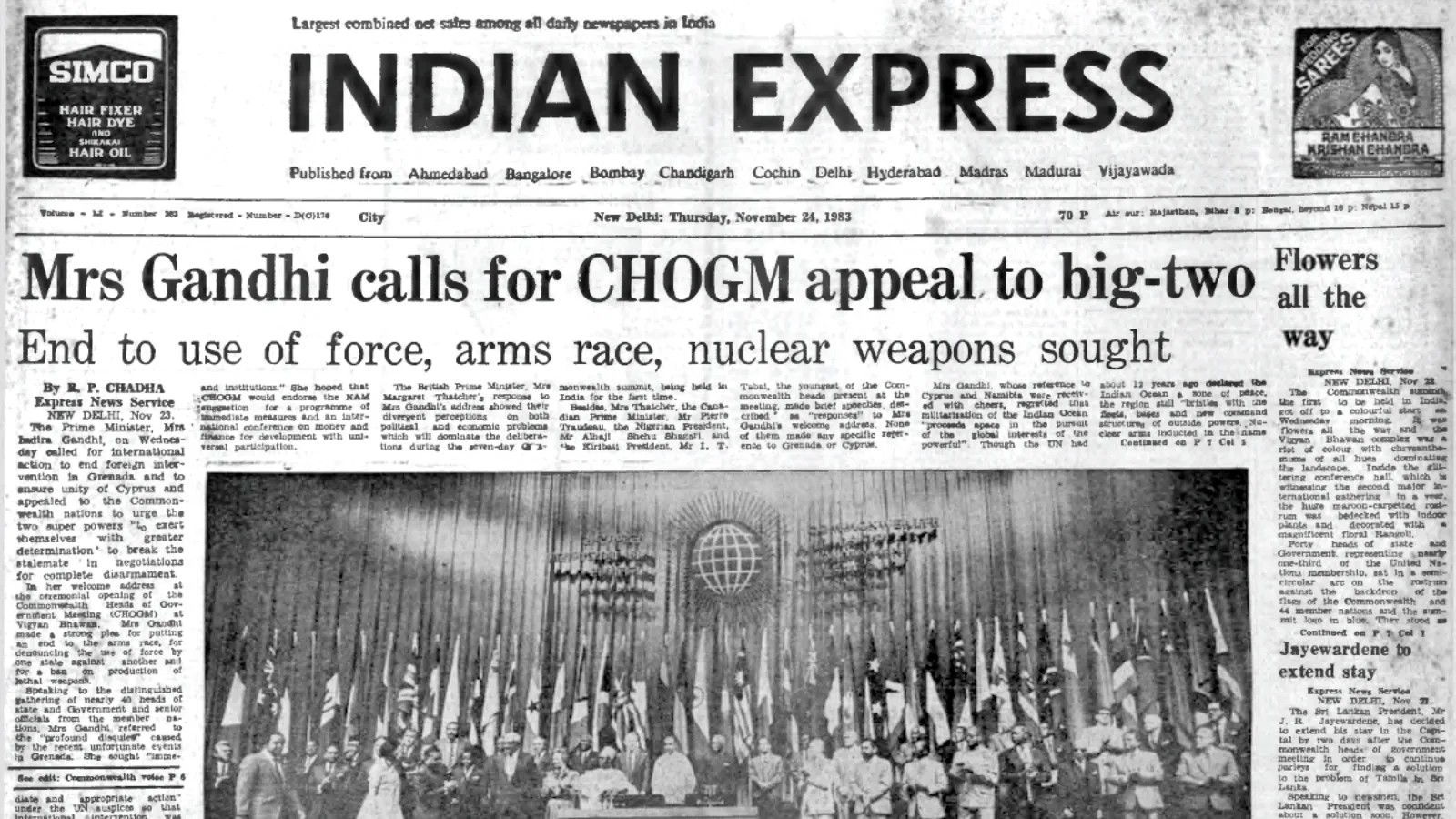
In November 1983, Delhi became the centre of the Commonwealth world when the Commonwealth Heads of Government Meeting was held. For a city accustomed to receiving important political leaders, it was nevertheless a moment of international significance. Heads of government from across the Commonwealth arrived, while Prime Minister Indira Gandhi took part in discussions at a time of Cold War tensions, a growing nuclear arms race and continuing struggles against apartheid. The meeting produced the Goa Declaration, which called for the peaceful settlement of disputes, an end to the nuclear arms race and greater protection for smaller states. For those of us living in Delhi in the 1980s, such events had a particular atmosphere: newspaper headlines, flags, heightened security and black-and-white television images of visiting leaders. For a few days, Delhi, without changing its essential character, had briefly become a stage on which the wider world had come to meet.
And then came cricket. The 1987 Cricket World Cup felt like the very essence of 1980s India. India and Pakistan jointly hosted the tournament, the first World Cup to be played outside England, and suddenly the cricketing world seemed to have arrived at our doorstep. Cricket in those days had its own atmosphere, cricket conversations at tea stalls and office corridors, radios and televisions carrying the excitement of every match, no mobile phones or instant updates. We waited for Doordarshan, for the commentator’s voice, for the score to appear on the screen. An India-Pakistan match could bring an entire neighbourhood to a standstill. We argued over every run, celebrated every wicket and carried the result into the next day’s conversations. The 1987 World Cup belonged to that slower, more collective era of cricket, when watching a match was not just entertainment; it was an event shared by almost everyone around us.
Looking back, what stays with me is not only the scale of these events but the strange familiarity of seeing the international world arrive in our city. Flags lined buildings, motorcades moved along roads we knew, important people appeared on our television screens, and security arrangements seemed extraordinary at the time. The world has come to Delhi many times since. The occasions have grown larger, the technology faster, and the city more practiced at receiving the world. But for many of us, that familiarity began in the 1980s, when we first discovered the world didn’t have to stay on the other side of the television screen. Sometimes, it came right down our streets. And Delhi, as always, made room for it.


