
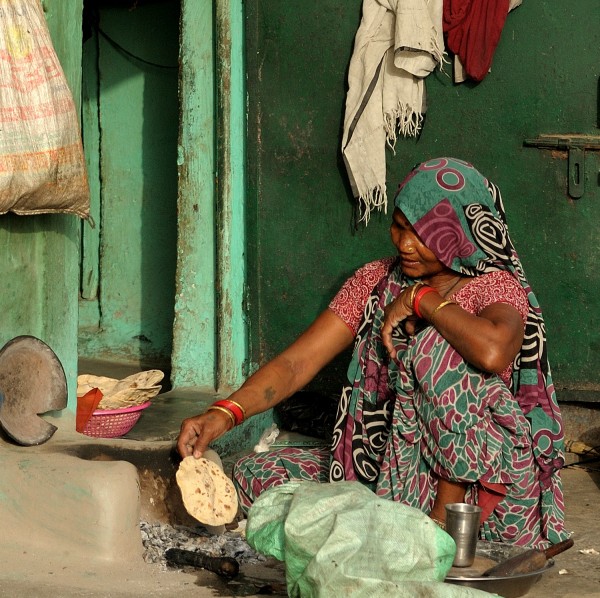

A woman making rotis, her hands moving between the rolling board and the hot tawa, is a familiar sight. A monkey holding a roti, looking rather pleased with itself, is less common, though not unusual in Delhi. We see rotis being made and eaten every day. Yet, sometimes, an ordinary sight can make us pause and look at something familiar a little differently.
I found myself thinking about roti and poetry when I came across these lines by the Hindi poet Manglesh Dabral. They capture, with remarkable simplicity, the curious connection between the everyday and the poetic.
Jo roti banata hai, kavita nahin likhta
Jo kavita likhta hai, roti nahin banata
Dono ka aapas mein koi rishta nahin dikhta.
Lekin woh kya hai
Jab ek roti khaate hue lagta hai
Kavita padh rahe hain
Aur koi kavita padhte hue lagta hai
Roti kha rahe hain.
(He who makes rotis does not write poetry,
He who writes poetry does not make rotis.
The two seem to have nothing in common.
And yet, what is it that happens
When eating a roti feels like reading a poem,
And reading a poem feels like eating a roti?)
What makes a roti feel like poetry, or a poem feel like a roti? Perhaps it is the way both can reach something deep within us, sometimes without our quite knowing why.
Roti is more than food. It carries memories of childhood kitchens, of mothers and grandmothers standing by the stove, of familiar smells and meals shared around a table. The sight of a roti puffing up on a hot tawa can bring back a world we thought we had left behind. In the hands of someone who makes it every day, there is a kind of skill and rhythm that rarely receives the attention it deserves. Roti also speaks of hunger and survival. It reminds us that before we can turn to poetry, art or philosophy, we must have something to eat. Hunger makes a mockery of social pretensions. In the face of it, caste, religion and status offer little comfort. The question of who gets to eat, who makes the food, and whose labour remains invisible is never merely about food.
For women, in particular, roti carries another meaning. The daily business of feeding a family can be an expression of love. Still, it can also become a form of confinement, an obligation so routine that the person performing it disappears behind the work. The same hands that knead the dough, roll the rotis and serve everyone else may have dreams and desires of their own. To recognise the dignity of this labour is not to romanticise it or pretend that love makes endless work effortless.
Perhaps this is where Mangesh Dabral’s poem matters. It does not simply place poetry and roti on opposite sides, with one belonging to the world of the mind and the other to the body’s demands. It asks us to recognise how closely the two can be connected. A poem without an awareness of life’s material realities risks becoming hollow. And a roti made with care, or earned through honest labour, can possess a beauty that needs no artistic label. Not every roti is a poem, just as not every poem nourishes us. Some meals are prepared and eaten hurriedly. Some poems leave us untouched. The point is not to turn every ordinary act into art, but to pay attention to the lives and labour that make our ordinary comforts possible.
Perhaps poetry is not always something we read. Sometimes it is something we recognise: in a roti puffing up on a tawa, in the hands that feed, or in a roti held in a monkey’s hand. One nourishes the body; the other nourishes something harder to name. And sometimes, just sometimes, each manages a little of both.


Photos and text by Prerna Jain.
