
Francis Newton Souza was one of the first painters from a newly independent India to achieve international recognition. He was a leading figure in India’s avant-garde movement. Souza was known for his bold lines and thick colour application. Breaking away from traditional Indian and Western classical styles, he transformed landscapes and cityscapes into expressive and bold compositions.
Two paintings by F. N. Souza adorned the walls of a house I recently visited. They depicted similar subjects- houses, trees and a landscape. The paintings, made thirty-one years apart, one in 1958 and the other in 1989, made me wonder what had changed in Souza’s approach to his subject. How time had shaped his way of seeing and interpreting the world.
In the first painting, a cluster of houses stands beneath a large, leafless tree. The buildings are outlined in dark, powerful strokes, their red and orange facades set against a deep blue sky. A patch of green ground in the foreground, while a narrow path or strip of land draws the eye towards the houses. The scene feels like a quiet European village, but it has little of the tranquillity one might expect from such a setting. The tree, with its thick trunk and angular branches, dominates the composition. The houses, with their sharply pointed roofs, uneven walls and dark windows, seem almost animated. Their forms are simplified, sometimes distorted, and held together by the force of the artist’s line rather than by any concern for photographic accuracy. The red and orange colours glow against the blue, while the green foreground counters the dark outlines. The result is a landscape that feels both still and charged with energy.

House and Church in Landscape (1958)

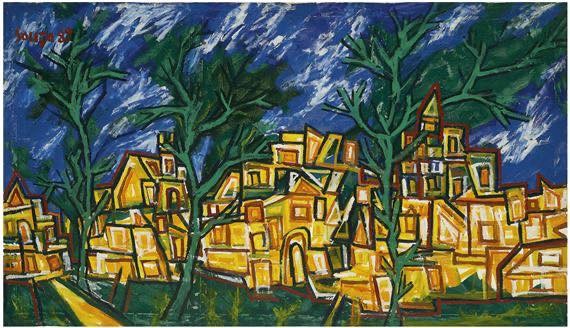
Yellow Buildings (1989)
The houses are brighter, more crowded and almost theatrical in the second painting. Yellow and ochre dominate the architecture, while the trees rise behind it in dark, jagged shapes. The brushstrokes in the sky are vigorous, giving it a restless quality. Unlike the first painting, where the bare tree is a commanding solitary figure, the second presents a dense arrangement of buildings and trees. Roofs overlap, walls tilt, and architectural details merge into an intricate pattern. The houses seem to press against one another, creating a rhythm of angular shapes and contrasting colours. The landscape has become an arrangement of forms and lines. The same artist at different moments, might see a similar subject differently.
In both the paintings, Souza’s outlines are bold, his perspectives unconventional, and his buildings don’t conform to the measured geometry we expect of architecture. The dark lines hold the compositions together, while the contrasting colours give them energy.
What struck me was not merely the difference in colour, composition or brushwork, but the way the artist’s vision seems to have changed. The earlier painting has a more defined, architectural quality, while the later work appears more expansive, energetic and expressive. The houses and trees remain recognisable, yet the world they inhabit seems quite different. A group of houses and a few trees could easily become a conventional landscape. In Souza’s hands, they acquire a character of their own. They seem to contain a little unease, a little drama and a great deal of energy.
These paintings are a part of a private collection, I have clicked pictures of the paintings.
