
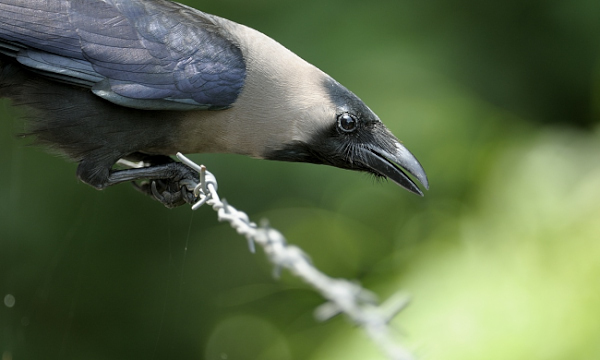

Crows are known for their black feathers, sharp beak, and loud cawing sound. They have a special place in folklore and literature. I don’t know about any bird other than the crow, which is associated with so many stories and superstitions.
Sant Kabir Das, a 15th-century Indian mystic poet, uses the crow as a metaphor while expressing the value of a sweet voice.
Kaga kako dhan hare, koel kako det
Meethe sabd sunaiy ke, jag apno kar let
( The crow does not steal anything, the koel does not give anything, but wins the love of the world due to its sweet songs.)
Kabir Das ji blamed the harshness of the crow’s voice for its not being loved. I wonder what the poor crow can do about its voice, or is he even willing to change it? The crow’s identity is based on its voice. The crow’s name in most Indian languages is based on the sound it creates. Kak in Sanskrit, kowwa in Hindi, kowla in Marathi, kagdo in Gujarati and kag in Bengali. About not taking or giving: the poor crow doesn’t get credit for caring for the koel’s babies. Koel is a brood parasite and lays eggs in the crow’s nest. The crow takes care of the koel’s babies, sometimes at the cost of its own eggs, although the crow is a predator of small birds and the eggs and young of birds.
In Padmavat, an epic composed by the medieval Sufi poet Malik Muhammad Jayasi, Nagmati, the first wife of King Ratan Singh, sends an emotional message to her husband through a crow and a bumblebee, saying that she has been reduced to ashes by the heat of separation from her beloved. The smoke from those ashes has turned the crow and the bumblebee black.
Piy saun kahehu sandesara ai bhanvra ai kaaga
so dhani birhen jari gayi tehik dhuan ham laaga
If we believe Nagmati, the crow is black because of a love story gone wrong.
There is a very popular old Hindi song-
jhooth bole kauwa kaate, kale kauwe se dariyo
(Be scared of a black crow, it bites you when you tell a lie)
Why should the crow be expected to be the moral police of society? Why is it expected to be scary? A scarecrow standing in the fields is not even close in looks to a crow, so why is it named so? Crow’s feet is the term used to describe the fine lines and wrinkles found at the outer corners of your eyes. Why are they called crows’ feet? They could have been sparrows’ feet or bulbuls’ feet, just because crows are not considered good-looking. If it is because of the black colour, it is out-and-out racism.
There are contradictory beliefs about the crow: wise, cunning, inauspicious, auspicious, and even dangerous. A group of crows is known as a “murder,” which sounds eerie. Thankfully, birders usually use the words “flock” or “mob”. The term ‘a murder of crows’ dates back to the Late Middle Ages and originates in Western folklore and literature. Crows have been associated with death, battlefields, and the supernatural, all because of their black feathers and harsh voices. Looks do matter.
Not all stories about the crows are about their looks or their voice. There is so much to the crows other than the black colour or the hoarse voice. They are known for their intelligence and problem-solving skills; they are definitely not “bird-brained”. Studies have shown that crows can recognise human faces and even communicate with one another. Crows are found in almost every part of the world and are highly adaptable. They are found in forests, cities, villages, and even deserts. The reason could be their flexible diet. Crows are omnivores; they eat fruits, seeds, insects, small animals, and even leftover human food. They are scavengers and can be seen searching for food in residential garbage bins, which may explain why they adapt so well to city life.
Crows are considered dirty because they eat garbage, yet on certain days, they are valued. In Hinduism, crows are regarded as messengers between the living and the departed. They are linked to spirits of departed ancestors and are offered food during rituals to please ancestors. In Hindu mythology, a crow is associated with Lord Shani. The belief is that the crow is the only bird that can cross the Vaitarani River, which separates the worlds of humans and ancestors. The crow is supposed to cross the river to take the feast to one’s ancestors. In Nepal, the first day of Tihar(Diwali) is called Kag Tihar, and people offer food to crows. There is a revered crow-sage in Hindu Mythology known as Kagbhusandi (or Kakbhushundi). A devotee of Lord Rama, he is believed to possess divine knowledge of time travel and to have witnessed the Ramayana multiple times. There is a sacred, high-altitude lake in Uttarakhand by his name.
Not just in India, crows are integral to mythologies around the world. Abel and Cain were the two sons of Adam. According to a story in the Quran, Cain killed Abel after a dispute. God sent a crow, which scratched the earth, so that he might show him how to bury the corpse of his brother. In Celtic mythology, crows were believed to be messengers of the goddess Morrighan. They symbolised battle and death. In Greek mythology, crows are associated with Apollo, but are often seen as gossipy or disobedient.
Crows are one of the smartest birds in the world. In the popular Aesop’s Fable, “The Thirsty Crow”, the crow intelligently uses its brain to quench its thirst. The crow saw a little water inside a jug, but his beak couldn’t reach it. He dropped pebbles one by one into the jug, so that the water level rose, and it was high enough for the crow to drink. The intelligent crow succeeded in his plan. I remember that whenever a crow visited our house, sat on the window and cawed, my grandmother would say, “Cook some extra food, expect some guests today.” Those were days when guests would just walk in without giving any prior information.
There was a popular Hindi film song, echoing the same belief,
Mori atariya pe kaga bole, mora jiya doley koi aa raha hai
(The heroine is singing merrily in excitement as she sees a crow cawing on her balcony; she thinks it is a sign that her love interest is visiting her.)
Until a few years ago, I sometimes heard commotion outside my house caused by noisy crows. I rarely see that happening now. I have witnessed a crowd of crows gathered around a wounded crow or a crow in need of help. I was fascinated by the clamour created by a mother crow when her baby fell down from the nest. She scolded her baby before rescuing it. Baby crows have beautiful, bright blue-grey eyes which turn into dark brown or black as they grow. I have seen a group of crows sitting quietly, and on other occasions, screaming and creating a ruckus as if they were about to attack the enemy army. A crow once cheekily stole a roti from my plate. I wouldn’t have realised that the crow was the thief if I hadn’t seen the crow, perched on the electric wire, quietly enjoying my roti, dripping in ghee, lovingly made by my grandmother. On another occasion, a crow swooped down from the tree to give a peck on my friend’s head while she was walking in a park, for no rhyme or reason, just for the heck of it. No hard feelings, there are some crazy specimens in all species.
The crows deserve respect as survivors and as intelligent birds. Urban India wastes enough food for the crows to flourish. I am surprised that their number hasn’t increased. At least in Delhi, I see more pigeons than crows.


Photos and text by Prerna Jain.
