
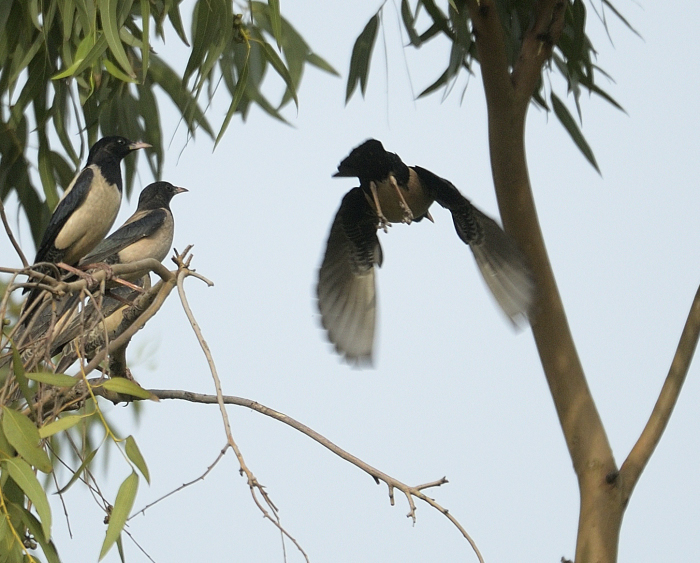
In April, the skies of Delhi witness a kind of magic. Flocks of black-and-white birds move like living waves, twisting and turning with breathtaking synchrony. These are Rosy Starling, passage migrants that pause briefly in our city during their long journey.
Hundreds of these birds can be seen during this time, stopping over as they travel from their wintering grounds in western and southern India and Sri Lanka to their breeding habitats across Central Asia and Europe. Delhi, with its abundance of flowering and fruit-bearing trees, offers them a perfect resting point, rich in food and safe roosting spaces.
The mesmerising, wave-like formations they create are known as murmurations. Most prominent in April, these formations can also be seen again in August, when the birds begin their southward journey. During this time, however, the flocks are more scattered, making the phenomenon less dramatic and harder to spot. Murmurations are best observed at dawn and dusk, moments of transition when the birds either leave their roosts or gather before settling in for the night. Beyond their visual beauty, these formations serve an important purpose. Moving together in large, coordinated groups helps the birds evade predators and enables communication and collective decision-making.
For a brief moment each year, Delhi’s chaotic skies transform into a canvas of rhythm and grace, reminding us of nature’s magic.

Rosy starlings are medium-sized birds with glossy black heads and pale pink bodies.


A murmuration of rosy starlings seen in South Delhi.
Pictures and text by Prerna Jain.
