
The frangipani tree, scientifically known as plumeria, is one of nature’s most elegant creations. With thick, sculpture-like branches, glossy leaves, and clusters of fragrant flowers, the tree seems to be designed by an artist.
Frangipani thrives in heat and survives neglect, blooms quietly, and perfumes the air. Native to Central America, Mexico, and the Caribbean, frangipani has travelled far from its home. In warm climates, it grows into a small tree with a broad canopy, while in cooler areas it survives as a shrub. Five-petaled, waxy white flowers with yellow centres are the most commonly seen flowers of this species. They can be in shades of pink, red, and peach.
Their smell has fascinated people for centuries. According to popular lore, the flower was named after the noble Frangipani family of Renaissance Italy. A member of the family, the perfumer Muzio Frangipani, is said to have created a famous fragrance worn by Italian aristocrats during the 16th century. The sweet-smelling tropical flower reminded the European botanists of the Frangipani scent, and the name stayed.
Across cultures, frangipani is popular for reasons far beyond its beauty. In India, it is commonly known as champa or araliya. Deeply woven into spiritual and cultural life, its fragrant blossoms are offered in temples and used in garlands during festivals and ceremonies. The flower is associated with purity, devotion, and divine beauty, and is often linked with Hindu deities.
In Buddhist traditions, frangipani symbolizes detachment and spiritual awakening. The tree’s ability to thrive even in harsh conditions is seen as a reminder of resilience and freedom from worldly attachments. Its white flowers, simple and luminous, are believed to reflect inner purity and the quiet pursuit of enlightenment.


In Southeast Asia and Bali, frangipani flowers adorn temples, shrines, and ceremonial offerings. In Laos, it is called dok jampa ( it is their national flower), and kamboja in Indonesia. The flower is considered sacred in Balinese culture.

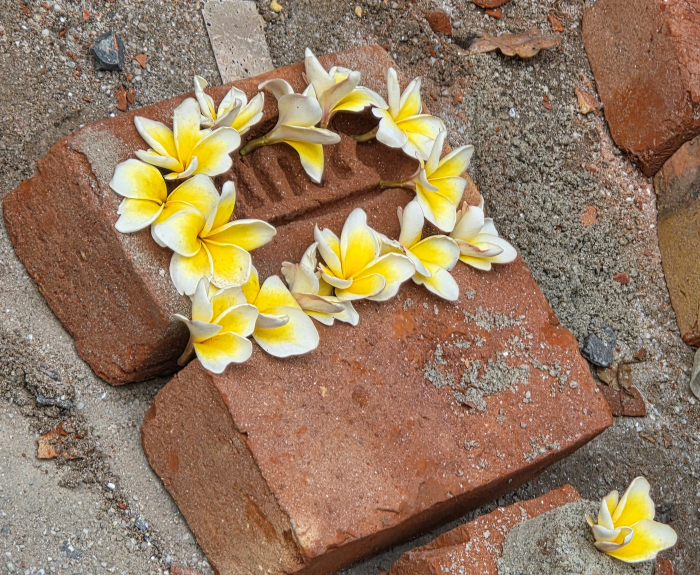
Kids at a construction site in Delhi decorated a brick with frangipani flowers.


Flower arrangement with frangipani and hibiscus.
Photos and text by Prerna Jain.
