
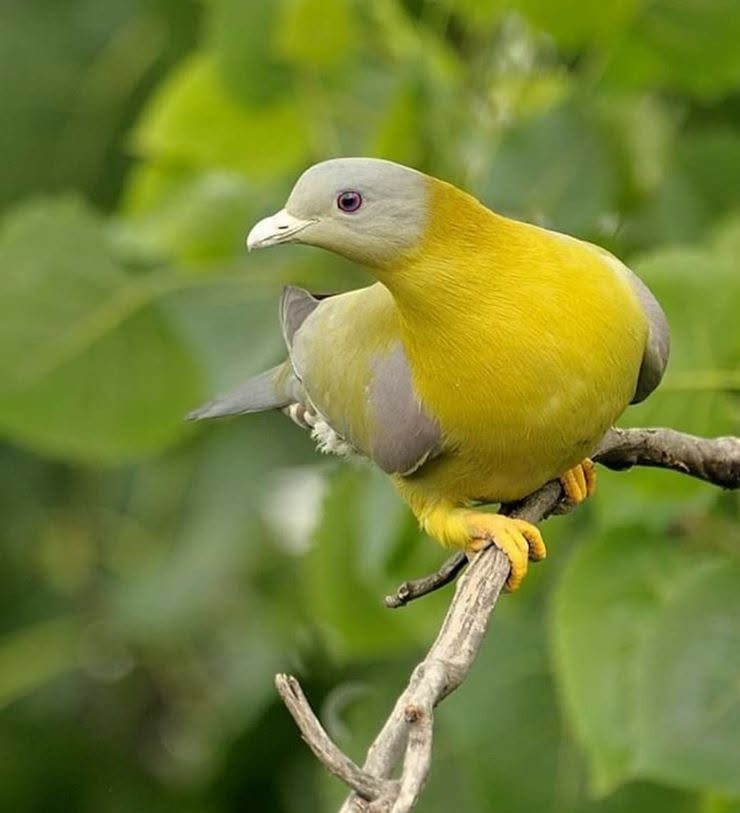
“Are you sure you are talking about a pigeon, not a parrot?” someone I met recently asked when I told her about a bright green pigeon with yellow feet.
“Yellow-footed Green Pigeons are pigeons in a parrot costume,” I replied with a smile.
I couldn’t blame her for the confusion. In Delhi, the pigeon we see most often is the familiar Blue Rock Pigeon. In our minds, a pigeon is supposed to be grey, slightly plump, and never particularly worried about where its next meal is coming from. There is an army of devoted humans feeding them at traffic lights, temples, and park benches.
A pigeon’s primary job description seems to be blessing the humans who feed it. Its secondary responsibility is redecorating statues, cars, park benches, and occasionally unsuspecting pedestrians with abstract white artwork.
The scientific name of the Hariyal, or Yellow-footed Green Pigeon, is Treron phoenicopterus. Hariyal simply means “green,” which perfectly describes the bird. The word Treron means shy or timid and appears in Homeric poetry as an epithet for a dove. Phoenicopterus, derived from Greek, means “red-feathered” and refers to the lilac patch on the bird’s shoulder. Put together, the name roughly translates to a shy pigeon with a lilac shoulder patch.
The Yellow-footed Green Pigeon cheerfully ignores most established pigeon traditions. It is green, has bright yellow feet, and prefers spending its time high in trees rather than strutting around crowded areas of the city.
You may spot one quietly perched among the branches, rhythmically flicking its tail up and down. These movements play a role in courtship and communication, helping birds advertise their presence to one another. Frequent tail flicking can also serve as an alert signal to the rest of the flock. When they take flight, their wings produce a distinctive whistling sound.
What makes the species especially fascinating is its camouflage. The bird blends so perfectly with the foliage that an entire flock can be sitting in a tree without attracting attention. What appeared to be a cluster of leaves on a large Peepal and Banyan trees may, on closer inspection, turn out to be a gathering of pigeons.
The Yellow-footed Green Pigeon is found across much of India, from the Himalayan foothills to the forests of the south, adapting to a variety of climates and habitats. They are regularly seen in the Delhi-NCR region. Feeding mainly on fruits, they also perform the important ecological service of dispersing seeds, helping forests regenerate naturally.
The next time someone is surprised that you have seen a bright green pigeon with yellow feet, look up. There is a good chance that the “parrot in a pigeon costume” is quietly watching from a nearby tree.


Greenish-yellow in colour, with blackish wings edged with yellow. It has a small lilac patch on the shoulder. The iris is blue with an outer circle of pink.

Juvenile Yellow-footed Green Pigeon.
Text and photos by Prerna Jain.
