
After reading the story of the unfortunate “Griff’s Pheasant,” I finally understood the true meaning of the Hindi/Urdu saying, “Murgi apni jaan se gayi aur khane wale ko maza nahin aaya” The chicken lost its life, yet the eater didn’t enjoy the meal. In other words, the sacrifice was entirely in vain.
“Griff’s Pheasant” was the nickname British recruits in India gave to the Greater Coucal (Centropus sinensis), also known as the Crow Pheasant. Mistaking this large, long-tailed bird for a pheasant, they hunted and ate it, only to discover that its meat had what they described as an “evil flavour.” Ironically, the bird is neither a crow nor a pheasant. In Punjab, it is known as Kamadi Kukkar, where kukkar means “chicken.”
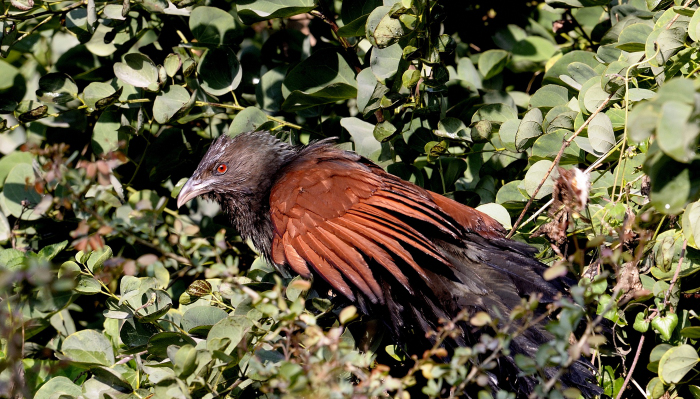
The Greater Coucal has a glossy black body, rich chestnut wings, and striking ruby-red eyes. Its glowing red eyes, coupled with its deep, resonant calls, have inspired countless legends across India. In many villages, it’s believed to foretell rain or predict good and bad fortune. Some traditional beliefs even claim that its nest contains a magical life-giving herb, while its flesh was once used as a folk remedy for tuberculosis and other pulmonary ailments. These beliefs have surrounded the bird with an aura of mystery for centuries.
Although the Greater Coucal is a weak flier, it is an accomplished hunter on the ground. It moves quietly through shrubs and grass in search of caterpillars, grasshoppers, beetles, snails, lizards, young mice, nestlings, birds’ eggs, and even snakes.
Early, cold mornings are the best time to observe this beautiful bird. It can often be seen sunning itself with its wings partially spread, soaking up the warmth before retreating into dense cover for the rest of the day.


Photos and text by Prerna Jain.
