
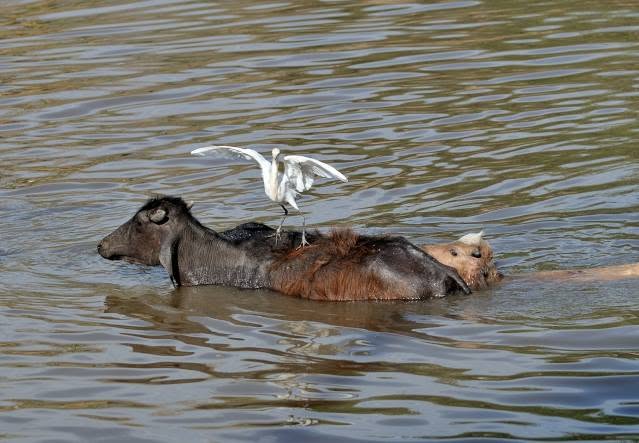


Imagine the joy of standing under a giant banyan tree, peacefully clicking candid photographs. Your subjects are blissfully unaware of your presence and are having the time of their lives, splashing about in muddy water. Then suddenly, a villain enters the scene. Traditionally, villains are portrayed as dark and intimidating, while heroines are fair and delicate. But this story turns that stereotype upside down. The heroine was black, bulky, and wallowing in mud. The villain was snowy white, graceful, and undeniably handsome. The world is changing, I guess.
During one of my road trips through rural India, I had stopped to photograph a young boy, barely into his teens, who was babysitting a herd of buffaloes. The buffalo family was enjoying a leisurely swim in the village johad (percolation pond). My attention was suddenly diverted by a Cattle Egret. The elegant white bird descended from the sky and landed neatly on the back of a buffalo. In my imagination, I heard the screeching sound of brakes being applied as a heavy vehicle came to an abrupt halt. The buffalo heard nothing. The braking sound existed only in my head. The buffalo, apparently, was not imaginative enough to hear it. Still, one would expect some reaction. A bird with sharp claws had landed unannounced on its bare back while it was enjoying a cool bath. I wasn’t expecting a lion-like roar, or a Bollywood-style “Bachao! Bachao!” from the victim. But a grunt of protest would have been reasonable. Even a flick of the tail to register displeasure. No reaction at all. I tried to understand the motives of the good-looking villain.
Why would a bird want to ride a buffalo? It can fly. I have seen Cattle Egrets glide through the air with effortless grace. They are not like the monkey in the Panchatantra story who needed a crocodile’s back to cross the river. Besides, the egret wasn’t being lured into a trap by a crocodile’s wife with questionable culinary ambitions. The answer came from the bird’s Arabic name: Abu Qerdan, “Father of Ticks.” Not exactly the glamorous title one would expect for such a stylish bird. Ticks, flies, mosquitoes, and other parasites that torment cattle happen to be among the egret’s favourite foods. The arrangement is simple. The buffalo provides transport and access to food. The egret removes blood-sucking parasites. A mutually beneficial friendship. The buffalo gets free pest control. The egret gets a buffet. Everyone goes home happy, except the ticks.
For a moment, my imagination wandered into dangerous territory. What if some future nutritionist declared ticks to be rich in Nutrient X and Nutrient Y? There would be YouTube debates. Celebrity chefs would invent gourmet tick recipes. Health influencers would argue about the best time of day to consume them. Fortunately, we are not there yet. Now that I understood their relationship, I began imagining a conversation between the two friends.
“Where have you been?” complained the buffalo. “You disappear whenever tick season arrives. These freeloaders have been making my life miserable.”
“First of all,” replied the egret indignantly, “it is rude to insult someone’s food. Second, I have a personal life. My partner was expecting, so I was busy collecting nesting material. Somebody had to build the nursery.”
“Congratulations! I remember when you were courting her. Those orange-buff plumes on your back, breast, and crown were quite impressive. Your bill and legs turned bright red too.”
The egret sighed.
“Life changes after marriage. As the saying goes, ‘Bhool gaye raag rang, bhool gaye chakdi; teen cheez yaad rahin, noon, tel, lakdi.’ I have forgotten music and merriment. Now it is all about groceries and household expenses.”
The buffalo chuckled.
“I know you. Once the chicks leave the nest, you will be back to showing off colourful feathers and flirting again.”
“Haha! You know me too well.”
“You lucky fellow,” continued the buffalo. “You can migrate wherever you want. Borders don’t stop you.”
“Of course not,” replied the egret. “As the old song says, ‘Panchi, nadiya, pawan ke jhonke, koi sarhad na inhe roke’(birds, rivers, and winds don’t respect political boundaries).”
“You still need us for food.”
“Please don’t be sensitive. Could you stir the water a little on your left? I spotted something delicious.”
The buffalo lazily flicked her tail.
A moment later, the unfortunate prey disappeared into the egret’s stomach.
I imagined a satisfied little burp.
“Leave some room,” said the buffalo. “We will walk through that grassy patch on the way home. I will shake the grass and flush out a few extra insects for you.”
“Thank you,” said the egret. “And thank you for the security. Hawks, kites, and eagles think twice before attacking me when I am near you.”
“There should be a campaign,” said the buffalo. “Insects Lives Matter.“
The egret laughed.
“You do have a sense of humour.”
“Just because you are handsome and elegant doesn’t mean you can get away with murder.”
“As the Sanskrit saying goes, Jeevo jeevasya bhojanam, every creature is food for another.”
The buffalo returned to her bath.
The egret returned to work.
And the ticks, unfortunately, had a very bad day.


Photos and text by Prerna Jain.


