
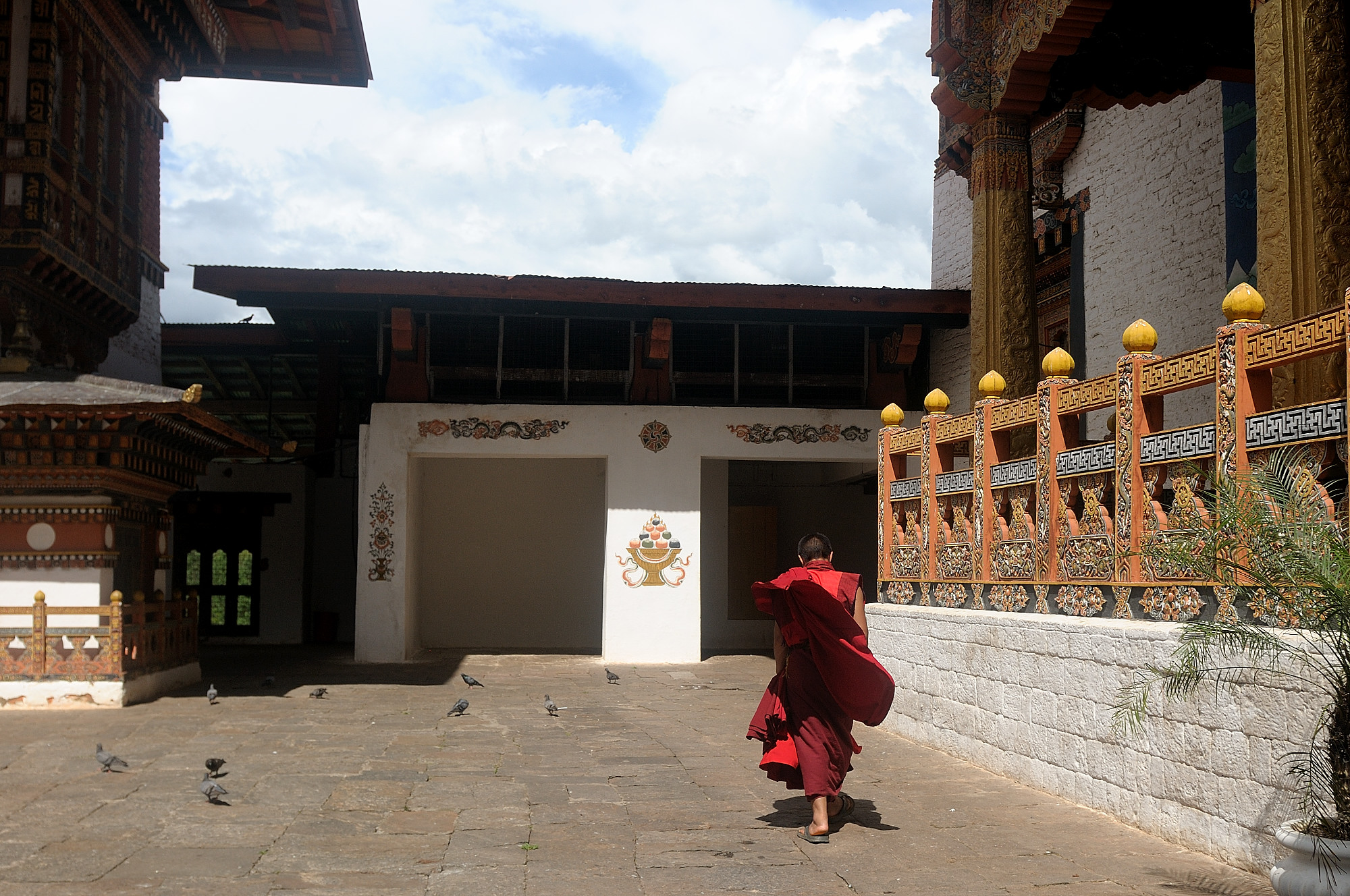

Bhutan is a country of mountains and prayer flags, winding roads and clouds that seem to have lost their way among the peaks. I visited Bhutan more than a decade ago expecting all that. What stayed with me was not only the spectacular landscape, but the silence. I live in Delhi, a city that seems incapable of being quiet. People are forever talking, arguing, honking, bargaining, laughing, calling out. The silence of Bhutan felt almost like entering another world.
The monasteries in Bhutan seemed to have grown out of the mountains rather than been built on them. They sit on cliffs, nestle into valleys, cling to hillsides and disappear into forests. Their whitewashed walls, wooden windows and brightly painted details seem less like architecture imposed on the landscape than something that belongs naturally to it. And then there is the absence of sound. You instinctively lower your voice when you enter a monastery. You hear the wind moving through pine trees, a distant stream, a bird calling from somewhere invisible, the soft murmur of prayers, the occasional turning of a prayer wheel, the flicker of butter lamps. Nobody seems to be in a hurry.
Bhutanese monasteries are anything but austere in appearance. Their exteriors may be white, but inside, colour erupts. Murals cover the walls. Deities stare down from painted panels. Intricate wooden carvings frame doors and windows. Red, yellow, blue and green appear everywhere. There are dragons, lotus flowers, mythical creatures, protective deities and scenes from Buddhist teachings. The first instinct is to photograph everything: the ornate doors, the murals, the monks, the prayer wheels, the butter lamps. Then, slowly, you begin to notice the smaller things. A monk’s red robe disappearing around a doorway. A shaft of sunlight falling across a wooden floor. A row of shoes left outside. The smoke of incense rising towards a painted ceiling. A prayer flag caught momentarily in the wind.
Punakha Dzong remains one of the most beautiful places I remember seeing in Bhutan. A dzong is more than a monastery; traditionally, it combines religious and administrative functions. In Bhutan, faith and governance are not necessarily expected to occupy separate worlds. Punakha Dzong stands at the meeting of the Pho Chhu and Mo Chhu rivers. The rivers do not seem to be there to provide a picturesque foreground. The mountains do not seem to have been arranged as a backdrop.The building simply belongs there.This is perhaps what struck me most about Bhutanese architecture. The buildings do not appear to be competing with nature. The mountains remain larger. The sky remains larger. The river continues to do what it has always done. The monastery is important. But that is not the whole story. Bhutan’s monasteries are not museums. They are alive. Monks walk through corridors. Young monks study. Prayer drums sound. Butter lamps are lit. Rituals continue whether or not a tourist happens to be holding a camera. Sacred places have not been turned entirely into scenery. You can sit. You can listen. You can watch clouds move across the mountains. You can hear monks chanting somewhere inside a building that may have stood there for centuries. And nobody asks you to buy anything.
Prayer flags are everywhere, in forests, across bridges, beside roads, on mountain passes and around monasteries. Blue, white, red, green and yellow flags flap wildly in the wind, carrying prayers into the air. I love the simplicity of the idea: prayers released into the wind, with no envelopes, email addresses or postal addresses required.
Bhutan is also known for the idea of Gross National Happiness, its attempt to think about progress in terms larger than economic growth. Whether one agrees with the philosophy, or debates how successfully it works in practice, the idea itself remains fascinating: that a country’s progress might be measured by something other than what can be counted in money.
I travelled to Bhutan expecting mountains. I came back thinking about silence. Perhaps that is what monasteries do. They don’t necessarily give you answers. They give you enough quiet to hear your own questions. Standing outside one of them, with prayer flags snapping in the wind and mountains rising behind them, I began to understand why people have been drawn to these places for centuries. For a few moments, the world disappears. The roads, the tourists, the cameras, the mobile phones are still there, the world loosens its grip.
Perhaps silence is not emptiness, it is where everything begins.


Photos and text by Prerna Jain.
