
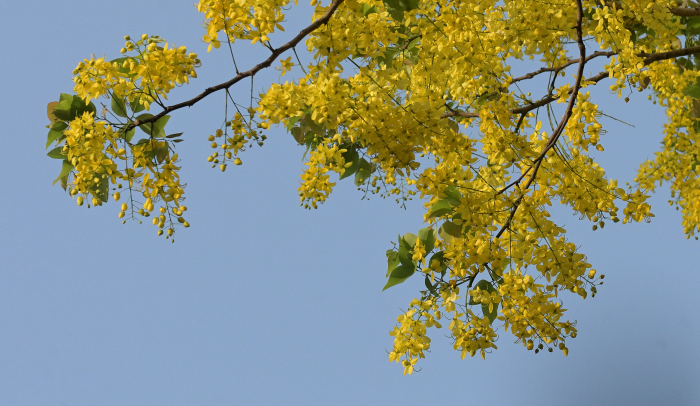
Long before weather forecasts and smartphone alerts, the blooming of the amaltaas signalled the arrival of Delhi’s hottest months. By early April, the tree sheds most of its leaves, leaving behind a network of slender brown branches. Then, as temperatures climb, soft yellow-green buds emerge. Within weeks, the transformation is complete: the canopy erupts into a cascade of golden flowers so dense that the branches seem to vanish.
Against a backdrop of parched earth, dusty roads, and shimmering heat, the amaltaas creates a beautiful spectacle. Clusters of bright yellow blossoms sway gently in the hot summer breeze, bringing colour and cheer to a harsh season. For a few weeks, streets and parks seem to be draped in gold.
When the flowering season ends, the tree adorns itself with long, dark seed pods that dangle from the branches like ornaments. These cylindrical fruits, fistula in Latin, contain rows of neatly arranged seeds. Their sweet-smelling pulp is relished by animals.
The amaltaas plays an important role in urban biodiversity. Bees, butterflies, and other pollinators flock to its nectar-rich flowers, while birds find shelter among its branches. Native to the Indian subcontinent and parts of Southeast Asia, the amaltaas has been admired for centuries. It is the state flower of Kerala, where it is known as Kanikonna and holds special significance during the festival of Vishu. Its golden blossoms are considered symbols of prosperity, renewal, and good fortune.
In Sanskrit, the tree is called Aragvadha, meaning “the disease killer.” Revered in Ayurveda, it has long been valued for its medicinal properties, and various parts of the plant are used in traditional remedies and tribal cuisine.

When Delhi’s summer seems relentless, the golden blooms of amaltaas transform dusty streets into golden avenues.


Birds often seek refuge among its branches.

Five overlapping petals in varied colours of yellow droop and make the flower beautiful.
Photos and text by Prerna Jain.
